
Ghaziabad Property Prices Fall 17% While Noida Surges 61%: What Should First-Time Buyers Do in August 2026?
Delhi NCR's property market is experiencing historic divergence: Ghaziabad residential prices fell 17% year-on-year, while Noida surged 61% over the same period, according to the Kotak Institutional Equities August 2026 report. This creates both opportunity and confusion for first-time buyers evaluating eastern NCR options. This comprehensive analysis examines fundamental drivers behind each trend, including oversupply and builder stress in Ghaziabad versus Jewar Airport catalyst and employment growth in Noida, micro-market variations showing where value exists in both cities, an honest assessment of whether Ghaziabad's decline represents buying opportunity or falling knife, an evaluation of whether Noida remains accessible after 61% appreciation, and practical decision frameworks for different buyer profiles based on budget constraints, workplace location, and investment timeline with current PropertyGuide. Online listings across both cities for real market comparison.
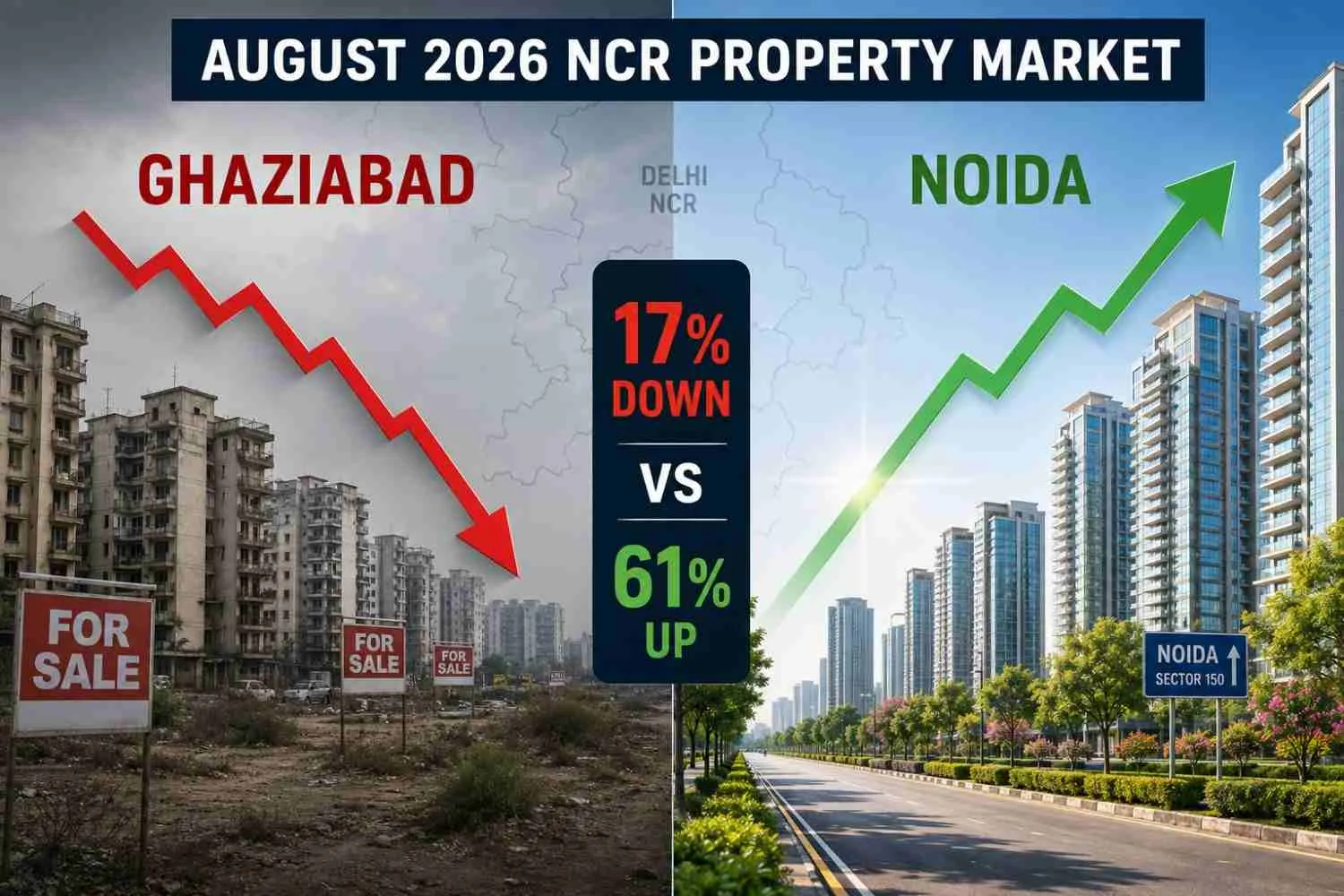
The Delhi NCR property market is experiencing one of its most dramatic divergences in years. While most of the region sees moderate price movements, two neighboring cities are moving in completely opposite directions: Ghaziabad property prices have fallen 17% year-on-year, while Noida has surged 61% over the same period, according to Kotak Institutional Equities' August 2026 NCR Real Estate Report.
For first-time homebuyers evaluating where to purchase in eastern NCR, these numbers create both opportunity and confusion. Does Ghaziabad's price drop signal a buying opportunity, or does it indicate fundamental problems that will lead to further declines? Does Noida's surge mean you have missed the boat, or is there still value despite the appreciation?
This analysis examines the Ghaziabad property prices fall 2026 phenomenon alongside Noida vs. Ghaziabad property 2026 dynamics with the honesty these questions deserve. We cover what is driving each trend, which micro-markets in both cities offer the best value for different buyer profiles, how to evaluate whether you are catching a genuine opportunity versus a falling knife, and practical decision frameworks for first-time buyers navigating this divergence.
The answers are not simple, and anyone claiming otherwise is selling something. But understanding the fundamentals behind these price movements gives you the information you need to make a decision aligned with your specific situation, budget, and timeline.
Ghaziabad's 17% Price Drop Explained: What the Data Shows
The Numbers in Context
According to Kotak Institutional Equities' NCR market analysis released in August 2026:
Ghaziabad residential property prices: -17% year-on-year (Aug 2025 to Aug 2026)
Average price per square foot: ₹4,200-₹5,800 (down from ₹5,100-₹7,000 in Aug 2025)
Sales velocity: Down 22% compared to the previous year
Inventory overhang: 18-24 months (significantly above the healthy 6-9 month range)
New project launches: Down 40% compared to 2025
This is not a minor correction. A 17% year-on-year decline in a market as large as Ghaziabad is significant and demands explanation.
Why Ghaziabad Prices Are Falling
Multiple factors are converging to create downward price pressure in Ghaziabad:
1. Oversupply from 2023-2024 Launches
Ghaziabad saw aggressive residential project launches in 2023-2024 as developers anticipated demand from the Delhi-Meerut RRTS (Rapid Rail Transit System). Total residential unit launches in 2023-2024 exceeded 25,000 units across multiple developers.
However, absorption has been slower than projected. Many projects launched with aggressive pricing expectations that the market has not validated. Developers facing slow sales have begun offering discounts, price corrections, and flexible payment schemes to move inventory, creating downward price pressure.
2. RRTS Impact Delayed and Less Transformational Than Expected
The Delhi-Meerut RRTS became operational in phases through 2025, with full corridor completion in early 2026. While connectivity improved, the residential property demand impact has been more modest than developers anticipated.
Why RRTS did not create the expected price surge:
-
Most RRTS users are existing Delhi commuters, not new Ghaziabad residents. The system improved commutes for people already living in Ghaziabad rather than attracting significant new in-migration.
-
Commercial office development in Ghaziabad remains limited compared to Noida or Gurugram. Without large employment centers near RRTS stations, the system functions primarily as outbound connectivity to Delhi rather than creating local economic nodes.
-
Residential preference still favors Noida among buyers who can afford both options. Noida's more established infrastructure, better civic amenities, and stronger brand perception continue to pull buyers away from Ghaziabad despite RRTS connectivity.
3. Competition from Noida and Greater Noida West
As Noida prices rose (covered in the next section), some buyer segments were indeed pushed toward more affordable alternatives. However, many of these buyers chose Greater Noida West over Ghaziabad due to:
- Planned Noida Metro extension to Greater Noida West (expected 2027-2028)
- Closer proximity to Noida's employment centers
- Perception of Greater Noida West as "next Noida" rather than being part of Ghaziabad
This competitive pressure limited Ghaziabad's ability to capture buyers priced out of Noida.
4. Builder Financial Stress and Project Delays
Several mid-size developers in Ghaziabad faced financial stress through 2025-2026, leading to construction delays, reduced marketing spend, and pressure to liquidate inventory at discounted prices. While RERA has improved buyer protections, builder financial weakness still affects market sentiment and pricing.
5. Infrastructure Delivery Gaps
While RRTS improved connectivity, other promised infrastructure has lagged:
- Road quality in several Ghaziabad sectors remains poor compared to Noida
- Water and power supply reliability issues persist in some areas
- Civic amenities (parks, schools, hospitals) development has been slower than in competing markets
- Law and order perception continues to favor Noida in buyer preferences
These gaps compound buyer hesitation and reduce willingness to pay premium prices.
Noida's 61% Surge: What Is Driving Demand?
The Numbers in Context
Kotak Institutional Equities' same report shows Noida's contrasting trajectory:
Noida residential property prices: +61% year-on-year (Aug 2025 to Aug 2026)
Average price per square foot: ₹6,800-₹9,500 (up from ₹4,200-₹5,900 in Aug 2025)
Sales velocity: Up 47% compared to the previous year
Inventory overhang: 5-7 months (healthy market range)
New project launches: Up 35% compared to 2025, primarily in Sectors 140-150 and Greater Noida West
This is one of the strongest appreciation cycles Noida has experienced, outpacing even the 2010-2012 boom in percentage terms.
Why Noida Prices Are Surging
Noida's price surge is being driven by fundamentals rather than speculation, though speculative elements are increasingly present:
1. Jewar Airport Catalyst Creating Real Demand
Unlike RRTS in Ghaziabad, the Noida International Airport at Jewar is creating measurable property demand through multiple channels:
Employment and Business Activity:
- Airport construction itself employs thousands directly and indirectly
- Aviation-linked businesses (logistics, hospitality, services) are establishing operations in the Yamuna Expressway corridor
- YEIDA (Yamuna Expressway Industrial Development Authority) reports over 150 company inquiries for land allotment near the airport zone since 2025
Investment and Speculation:
- Institutional investors, HNIs, and domestic capital are acquiring land and property along the Yamuna Expressway corridor, anticipating long-term appreciation
- NRI buyers are returning to the Noida market specifically citing Jewar Airport as the catalyst
Perception Shift:
- Noida is increasingly viewed as "future-proof" due to dual airport access (IGI and Jewar)
- Corporate location decisions are beginning to factor in Jewar proximity, supporting office market demand that indirectly supports residential
Timeline Effect:
- With Phase 1 operations expected 2025-2026, the airport has moved from "future promise" to "imminent reality," triggering demand from buyers who previously waited
2. Metro Network Maturity and Expansion
Noida's Delhi Metro Blue and Aqua Line coverage is now comprehensive across Sectors 51-150. Unlike Ghaziabad, where RRTS is one line, Noida's metro network creates multiple well-connected residential zones.
Metro Phase 4 extensions and the proposed Greater Noida West metro connectivity (2027-2028 timeline) are adding future infrastructure certainty that supports current pricing.
3. Employment Growth in Established IT Corridors
Noida Sector 62 and the Expressway sectors (125-142) continue to attract technology companies, Global Capability Centers, and corporate expansions. Employment growth in these corridors creates sustained residential demand from professionals seeking proximity to workplaces.
Unlike Ghaziabad, which largely functions as a bedroom community for Delhi employment, Noida has substantial local employment generation that creates intrinsic residential demand.
4. Supply Discipline Among Established Developers
Major developers in Noida (DLF, Godrej, Mahagun, ATS, etc.) have been more disciplined about supply than Ghaziabad's builder community. New project launches have been calibrated to absorb existing inventory rather than flooding the market, supporting price stability and appreciation.
5. Brand Perception and Civic Infrastructure Quality
Noida's brand perception as a well-planned, well-governed city continues to strengthen relative to other NCR alternatives:
- Noida Authority's professionalization and new administrative headquarters
- Better road quality and maintenance compared to Ghaziabad
- Lower crime perception compared to some Ghaziabad areas
- Established schools, hospitals, and retail infrastructure
These qualitative factors translate into pricing power that Ghaziabad struggles to match.
Ghaziabad vs. Noida Price Comparison—Micro-Market Analysis
Not all of Ghaziabad is declining equally, and not all of Noida is equally expensive. Understanding micro-market dynamics helps identify specific opportunities.
Ghaziabad Micro-Markets—Where Prices Have Fallen Most and Least
| Locality | Current Price PSF | YoY Change | Why | Buyer Suitability |
|---|---|---|---|---|
| Vaishali | ₹5,200-₹6,800 | -12% | Metro-connected, relatively stable | First-time buyers wanting Delhi connectivity |
| Indirapuram | ₹5,500-₹7,200 | -14% | Established but aging, facing competition | Families prioritizing schools and community |
| Crossing Republik | ₹3,800-₹5,200 | -22% | Oversupply, builder stress, peripheral location | Extreme budget buyers, high risk tolerance |
| Raj Nagar Extension | ₹3,500-₹4,800 | -19% | Heavy oversupply, infrastructure gaps | Budget buyers, risky |
| Kaushambi | ₹6,200-₹7,800 | -8% | Metro access, closer to the Noida border, holding better | Buyers wanting Ghaziabad affordability with better connectivity |
| Sahibabad | ₹4,800-₹6,200 | -15% | Industrial character, RRTS station nearby | Industrial workers, limited residential appeal |
| NH-24 Corridor | ₹4,200-₹5,600 | -18% | Highway noise, uneven development | Price-sensitive buyers, mixed reception |
Key Insights:
- Metro-connected Ghaziabad areas (Vaishali, Kaushambi) are declining less because connectivity supports base demand
- Peripheral oversupplied zones (Crossing Republik, Raj Nagar Extension) are seeing steepest declines due to excess inventory and builder distress
- Established residential townships (Indirapuram) are declining but remain relatively stable due to existing community and social infrastructure
Noida Micro-Markets—Where Value Still Exists Despite Surge
| Locality | Current Price PSF | YoY Change | Why | Buyer Suitability |
|---|---|---|---|---|
| Sector 75-78 | ₹6,500-₹8,200 | +42% | Metro-connected, established, affordable end of Noida | First-time buyers wanting Noida at a lower entry point |
| Sector 137-144 | ₹7,200-₹9,800 | +68% | Aqua Line, expressway access, strong demand | Mid-market buyers, good appreciation potential |
| Sector 150 | ₹8,500-₹11,500 | +58% | Premium sector, sports city, high amenities | Premium buyers, families |
| Greater Noida West | ₹4,800-₹6,500 | +72% | Steepest appreciation, metro extension planned | Budget Noida buyers, highest risk-reward |
| Sector 62-63 | ₹9,000-₹12,000 | +35% | Established IT hub, commercial demand supports residential | Professionals working in Sector 62, premium |
| Sector 121-122 | ₹7,800-₹10,200 | +55% | Emerging corridor, good connectivity | Growth-oriented buyers |
| Noida Extension (Greater Noida West) | ₹4,500-₹6,200 | +70%+ | Fastest growth, most speculative | Early-stage investors, long holding period |
Key Insights:
- Established Noida sectors (75-78, 62-63) saw moderate appreciation, indicating relatively stable demand-driven growth
- Emerging corridors (137-144, Greater Noida West) saw explosive growth, indicating a mix of genuine demand and speculative capital
- Premium sectors (150) appreciated strongly but from an already-high base, reflecting Noida's upmarket shift
- Greater Noida West appreciation is highest but also most volatile—contains both opportunity and risk
Ghaziabad Price Drop: Opportunity or Falling Knife?
For first-time buyers, the critical question is whether Ghaziabad's 17% decline represents a buying opportunity or a warning sign.
Arguments for "This Is an Opportunity"
✅ Entry prices are now substantially below Noida — ₹3,500-₹5,800 PSF vs ₹6,800-₹9,500 PSF creates affordability for budget-constrained buyers.
✅ RRTS infrastructure is operational—connectivity to Delhi is genuine and functional, not a future promise.
✅ Oversupply will eventually clear—Current excess inventory is painful for developers but creates a buyer's market with negotiation leverage.
✅ Long-term NCR growth includes Ghaziabad—Over 10-15 years, Ghaziabad's location within NCR and connectivity should support gradual appreciation.
✅ Rental yields may be attractive—Lower purchase prices with stable rental demand could offer 4-5% yields for rental income investors
✅ Builder distress creates deals—Financially stressed builders offering discounts, freebies, and flexible payment plans provide value for informed buyers.
Arguments for "This Is a Falling Knife"
❌ Fundamental demand is weak, not just oversupply—if demand were strong, excess inventory would clear faster; slow absorption suggests limited buyer interest.
❌ RRTS did not create the employment/ecosystem needed—connectivity alone does not drive property appreciation; employment and economic activity do, and Ghaziabad lacks this.
❌ Noida and Greater Noida West capture Ghaziabad's potential demand—buyers willing to stretch budget slightly often choose Noida alternatives over Ghaziabad.
❌ Further correction is possible—if inventory continues not clearing, builders may cut prices further; -17% could become -25% before stabilization.
❌ Resale liquidity is poor—buying in a falling market means you may struggle to sell when you need to; Ghaziabad's secondary market is thin.
❌ Infrastructure gaps remain unaddressed—road quality, civic amenities, and governance issues that drive the price decline are not being fixed rapidly.
Balanced Assessment
Ghaziabad is an opportunity for specific buyer profiles:
✓ Extreme budget buyers (₹30-50 lakh total budget) who cannot afford Noida even at entry level
✓ Rental income investors who can hold 7-10 years and want yield over appreciation
✓ Buyers who work in Delhi/Ghaziabad and value RRTS commute convenience over Noida brand
✓ Buyers who can wait out the correction—if you do not need to sell in the next 5 years, eventual market recovery is plausible
Ghaziabad is risky for:
❌ Buyers expecting short-term appreciation (3-5 years)—Further downside or stagnation is more likely than appreciation.
❌ Buyers who may need to sell soon—Illiquid market means difficult exit
❌ Buyers stretching budget assuming value will improve—if the market stays weak, you are stuck with overpriced assets.
Noida's 61% Surge: Still Accessible or Too Late?
The flip side question: Has Noida's appreciation priced out first-time buyers, or is there still value?
Arguments for "There Is Still Value in Noida"
✅ Fundamentals support prices—Jewar Airport, employment growth, metro connectivity, and quality infrastructure justify premium over Ghaziabad.
✅ Sectors 75-78 and Greater Noida West still offer entry points—₹4,800-₹8,200. ₹4,800-₹8,200 The PSF range is accessible for first-time buyers with ₹60-80 lakh budgets.
✅ Appreciation has room to continue—if Jewar Airport becomes operational as scheduled and delivers expected economic activity, current prices may seem reasonable in hindsight.
✅ Rental demand is strong—even if appreciation slows, Noida's rental market depth provides income stability.
✅ Resale liquidity is significantly better than Ghaziabad—if you need to sell, Noida's active secondary market provides exit options.
Arguments for "Noida Is Overheated"
❌ 61% YoY appreciation is unsustainable—markets cannot compound at this rate indefinitely; correction or stagnation becomes more likely after such a rapid run-up.
❌ Speculative capital is present—some buyers are purchasing not for use but for flipping, which creates bubble risk.
❌ Affordability is deteriorating rapidly—first-time buyers who could afford Noida 18 months ago may now be priced out.
❌ Jewar Airport timeline and impact uncertainty—if airport operations delay or economic impact disappoints, speculative premium could deflate quickly
❌ Alternative NCR markets offer better value—Gurugram's Dwarka Expressway corridor and Faridabad's NH-19 belt may offer better risk-adjusted returns.
Balanced Assessment
Noida still makes sense for:
✓ Buyers prioritizing quality of life and infrastructure over absolute affordability
✓ Buyers who can afford ₹70 lakh+ budgets and want established amenities
✓ Buyers working in Noida/Greater Noida where proximity to employment justifies premium pricing
✓ Long-term holders (7-10 years) who believe Jewar Airport will deliver transformational impact
Noida is challenging for:
❌ Buyers with ₹40-60 lakh budgets—Noida's entry point has moved beyond this range except in most peripheral areas
❌ Buyers expecting rapid short-term appreciation—After 61% gain, near-term upside may be limited
❌ Buyers who need absolute value—if budget is paramount, Ghaziabad or Greater Noida West offer lower entry despite risks.
First-Time Buyer Decision Framework: Price vs Connectivity vs Future Growth
Rather than declaring one city "better," let's build a framework for your specific situation.
If Your Primary Constraint Is Budget
Budget: ₹30-50 Lakh:
Best Option: Ghaziabad (Vaishali, Kaushambi, or Indirapuram)
Why: Noida and even Greater Noida West are largely inaccessible at this budget. Ghaziabad offers 2BHK options in this range.
Risk Mitigation: Buy only in metro-connected areas. Verify the builder's RERA registration and completion timeline. Plan to hold 7+ years. Do not expect appreciation; focus on stable housing.
Budget: ₹50-70 Lakh:
Best Option: Greater Noida West or Ghaziabad (better areas)
Why: Greater Noida West offers Noida proximity and planned metro at prices Ghaziabad matches. Choose based on commute.
Risk Mitigation: In Greater Noida West, buy only RERA-registered projects from established builders. In Ghaziabad, prioritize Vaishali/Kaushambi for metro access.
Budget: ₹70 Lakh-₹1 Crore:
Best Option: Noida Sectors 75-78, or Greater Noida West premium projects
Why: This budget accesses entry-level Noida in established sectors with full infrastructure.
Risk Mitigation: Avoid overpaying in Greater Noida West hype. Compare Noida Sector 75-78 options, which offer better infrastructure at similar pricing.
Budget: ₹1 Crore+:
Best Option: Noida Sectors 137-144, 150, or Sector 62-63 if premium office proximity
Why: At this budget, optimize for quality, not price. Noida's established corridors deliver infrastructure, amenities, and resale liquidity.
Risk Mitigation: Verify that appreciation expectations are realistic. After the 61% run-up, do not assume another 50% in the next 3 years.
If Your Primary Constraint Is Commute/Workplace Location
Work in Delhi (Connaught Place, Central Delhi):
Best Option: Ghaziabad (Vaishali, Kaushambi) via RRTS, or Noida Sector 62-63 via Metro Blue Line
Why: RRTS offers a 20-30 min commute from Ghaziabad to Delhi. Metro Blue Line does the same from Noida.
Trade-off: Pay the Noida premium for better infrastructure, or save with Ghaziabad pricing and accept infrastructure gaps.
Work in Noida Sector 62 or Expressway Sectors:
Best Option: Noida Sectors 75-78, 137-144
Why: Proximity to employment makes daily commutes manageable. Residential sectors near Sector 62 offer the best lifestyle.
Avoid: Ghaziabad would create reverse commutes daily, wasting time.
Work in Gurugram:
Best Option: Neither Noida nor Ghaziabad is optimal. Consider the Dwarka Expressway corridor or Gurugram itself.
Why: Daily cross-NCR commute from Noida/Ghaziabad to Gurugram is painful (90+ minutes each way).
Work in Ghaziabad or Work-from-Home:
Best Option: Ghaziabad (if budget-constrained) or Noida (if prioritizing quality)
Why: Without daily commute constraints, optimize based on budget and lifestyle preference.
If Your Primary Goal Is Investment/Appreciation
Short-Term (3-5 years):
Best Option: Avoid both
Why: Ghaziabad is falling and may continue. Noida, after a 61% surge, faces a correction risk. Short-term appreciation is speculative in both.
Alternative: If you must invest short-term, established Noida sectors (75-78) offer more stability than Ghaziabad or speculative Greater Noida West.
Medium-Term (5-7 years):
Best Option: Noida Sectors 137-144 or Greater Noida West (high risk/reward)
Why: The Jewar Airport impact will materialize in this timeframe if it happens. Ghaziabad is unlikely to recover meaningfully in 5-7 years without new catalysts.
Risk: Noida's speculative premium could deflate if Jewar disappoints.
Long-Term (10+ years):
Best Option: Either, based on entry price
Why: Over 10+ years, both cities will likely appreciate as NCR grows. Ghaziabad's current low prices may offer better percentage returns long-term despite weak fundamentals.
Strategy: In Ghaziabad, buy only in the best locations (Vaishali, Kaushambi). In Noida, any metro-connected sector works for long holding.
Current Listings on PropertyGuideOnline in Both Cities
Rather than speculating on future price movements, explore current available properties across both Noida and Ghaziabad to compare actual market offerings.
PropertyGuideOnline Advantages for Noida and Ghaziabad Buyers
PropertyGuideOnline provides:
✓ Verified listings across both cities with a verified badge system
✓ Zero brokerage—Connect directly with owners and save 1-2% commission
✓ Free property listing for owners and brokers
✓ Detailed information—Complete specifications, photos, pricing, and RERA registration where applicable
✓ Direct comparison—Search both Noida and Ghaziabad simultaneously to compare options.
✓ Commercial and residential coverage—Both asset classes available
Featured Commercial Opportunities in Noida
For investors or businesses seeking commercial property in Noida's established corridors that have proven demand fundamentals:
One Estate 62—Grade-A office space in Noida's premier Sector 62 IT corridor with metro connectivity and corporate tenant base
Bhutani Cyber Park—Technology-enabled commercial development in Sector 62 targeting modern enterprises
Maasters Capitol Avenue — Competitive office space in Sector 62's commercial belt with developer credibility
These represent current operating commercial markets in Noida with tenant demand today, not speculative future possibilities.
How to Search Both Cities on PropertyGuideOnline
- Visit PropertyGuideOnline.com
- Use the location filter to select "Noida" or "Ghaziabad."
- Set a budget range based on your affordability
- Filter by BHK configuration, property type, and possession status
- Compare listings side-by-side across both cities
- Contact owners directly with verified contact information
- Schedule site visits to properties in both cities before deciding
Start your search: PropertyGuideOnline Delhi NCR Listings
What Should First-Time Buyers Do Right Now?
Given the market dynamics, here is practical guidance:
Actions to Take Immediately
☐ Define your absolute budget—not aspirational, but realistic based on your income, savings, and loan eligibility.
☐ Clarify your primary constraint—Is it budget, commute, or appreciation? You cannot optimize all three equally.
☐ Visit both cities—see properties in Ghaziabad's Vaishali and Noida's Sector 75-78 to compare infrastructure quality firsthand
☐ Calculate total cost of ownership—Include property price, registration, interior work, maintenance, property tax, and commute costs.
☐ Verify builder credentials—Check RERA registration, past project delivery, and online reviews before committing.
☐ Get pre-approved for a home loan—Know your exact loan eligibility before falling in love with unaffordable property.
Strategic Approaches by Buyer Type
Budget-Constrained Buyers (₹30-60 Lakh):
→ Prioritize Ghaziabad but only in metro-connected areas (Vaishali, Kaushambi).
→ Verify resale market — Talk to local brokers about how long properties take to sell in your target area
→ Plan to hold 7-10 years—Do not buy in Ghaziabad if you may need to sell in 3-5 years.
→ Negotiate hard—Builder distress means negotiation leverage; use it.
Mid-Budget Buyers (₹60-90 Lakh):
→ Compare Greater Noida West and Ghaziabad carefully—similar pricing, very different infrastructure
→ Prioritize metro connectivity—whether Ghaziabad RRTS or Greater Noida West's planned metro—confirm it is operational or genuinely committed.
→ Consider Noida Sector 75-78—slightly higher price but significantly better infrastructure may justify cost.
→ Factor in future income growth—if you expect salary growth, stretching slightly for Noida may make sense.
Premium Buyers (₹90 Lakh+):
→ Buy in Noida unless specific reasons favor Ghaziabad
→ Accept current pricing: After 61% appreciation, waiting for "correction" may mean waiting indefinitely
→ Prioritize quality and liquidity: At this budget, infrastructure quality and resale liquidity matter more than absolute price
→ Verify Jewar impact assumptions: If your purchase decision assumes Jewar-driven appreciation, research airport timeline and impact studies independently.
What to Avoid
❌ Do not buy in Ghaziabad assuming Noida-like appreciation: Fundamentals are different.
❌ Do not buy in Noida's periphery assuming guaranteed returns: 61% gains are not repeatable annually.
❌ Do not buy from financially distressed builders without legal protection—builder bankruptcy risk is real.
❌ Do not buy based on promises of future infrastructure: Buy based on operational infrastructure only.
❌ Do not overleverage: Keep EMI below 40% of monthly income
Conclusion: No Universal Right Answer — Only Your Right Answer
The divergence between Ghaziabad's 17% decline and Noida's 61% surge creates both opportunity and confusion. But searching for a universal "better" city misses the point. The right decision depends entirely on your specific budget, workplace location, timeline, risk tolerance, and what you value most, absolute affordability, infrastructure quality, or appreciation potential.
Ghaziabad makes sense if you are budget-constrained, value RRTS connectivity to Delhi, can hold long-term, and buy only in metro-connected established areas from stable builders.
Noida makes sense if you can afford the premium, prioritize quality of life and infrastructure, work in Noida or eastern NCR, and believe Jewar Airport will deliver long-term value.
Greater Noida West may make sense as a middle ground if you prioritize Noida proximity at near-Ghaziabad pricing and accept infrastructure development timeline uncertainty.
Neither may make sense if your workplace is in Gurugram, your budget is extremely tight (below ₹30 lakh), or you need short-term liquidity and cannot commit to a 5+ year holding period.
The honest answer is: there is no guaranteed right choice. There are only informed trade-offs. Understand what you are gaining and giving up with each option. Verify all claims independently. Buy based on operational infrastructure, not promises. Size your purchase to your genuine affordability, not maximum loan eligibility.
And most importantly, make a decision you can live with comfortably for the next 7-10 years regardless of short-term market movements, because that is the realistic timeframe required for any residential property purchase to prove its wisdom.
Explore current property options across both Noida and Ghaziabad at PropertyGuideOnline.com with verified listings, zero brokerage, and direct owner contact to compare real available properties and make your decision based on actual market offerings, not speculation.
This article is based on publicly available market data, including the Kotak Institutional Equities NCR Real Estate Report August 2026, Delhi NCR property market trends, and buyer transaction patterns. All price movements, micro-market assessments, and forward projections are subject to change. No content constitutes guaranteed investment returns or property purchase recommendations. Consult qualified property advisors, conduct independent due diligence, and verify all claims before making property purchase decisions.